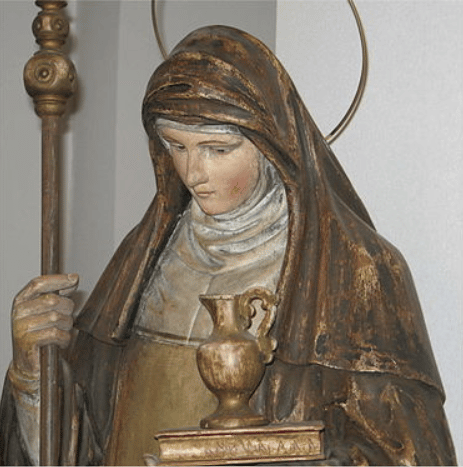
Saint Walburga, abbess and virgin
Saint Walburga, born in England, was the daughter of Saint Richard, king of the West Saxons. She was born around 710 and was just eleven years old when her father and her two brothers Vunibaldo and Vilibaldo left on a pilgrimage to the Holy Land. She was entrusted, together with her mother, to the Abbess of Wimburn. In 722 his father died on the way back.
Life and Mission of Saint Walburga
He received an austere education at Wimburn. He wrote the life of his brother Saint Vilibaldo and composed in Latin a narrative of Saint Vilibaldo's travels through Palestine. In 748, at the request of Saint Boniface, his abbess, Tetta, sent her to Germany with a few other nuns to found monasteries and schools among newly converted populations. On the journey, a great storm was calmed by Walburga's prayers. It was with holy joy that Bonifácio welcomed the nuns.
Vilibaldo had built an abbey of monks in Heidenheim, in the diocese of Eichstadt. Walburga, after spending some time in Bischofsheim, under the abbess Lioba, went to meet her brother, who was planning a female abbey in Heidenheim. Valburga became abbess of this new foundation; it appears that, after Vilibaldo's death, she ruled over nuns and monks.
The sanctity of his life was evident in the examples of mortification he gave, as well as in his love of silence and his devotion. She was animated by true zeal for the service of God. She had a lot of prudence and gentleness in governing her community, and, through her, God performed many miracles.
The miracles of Saint Walburga
Two miracles became famous in her life: one, the supernatural light that enveloped her cell and illuminated the Sisters' dormitory, a light that she attributed to the merits of Saint Vilibaldo, her brother; the other, that of the healing of a baron's daughter, with whom she remained in prayer, obtaining the girl's perfect cure at the end of the night.
In 776, Santa Valburga attended the transfer of the body of her brother Vunibaldo, presided over by her other brother, Vilibaldo, then bishop of Eichstadt. Shortly afterwards, she fell ill and died, assisted in her last moments by her brother Vilibaldo.
Walburga's body, buried in her monastery in Heidenheim, remained there for nearly eighty years, until it was transferred to Eichstadt. This took place under the orders of Bishop Otkar, being qualified as canonization, and caused the multiplication of festivities in honor of the Saint.
The incorrupt body
The Saint's body was found incorrupt and covered in a wonderful fluid like pure oil. The same was noted when, in 893, Otkar's successor placed the relics under the main altar of the church he dedicated to the Saint. The oil continued, at certain times, to flow from his tomb drop by drop into a silver ladle prepared to receive it. The oil put in bottles is sent all over the world and works innumerable miracles, even in our days.