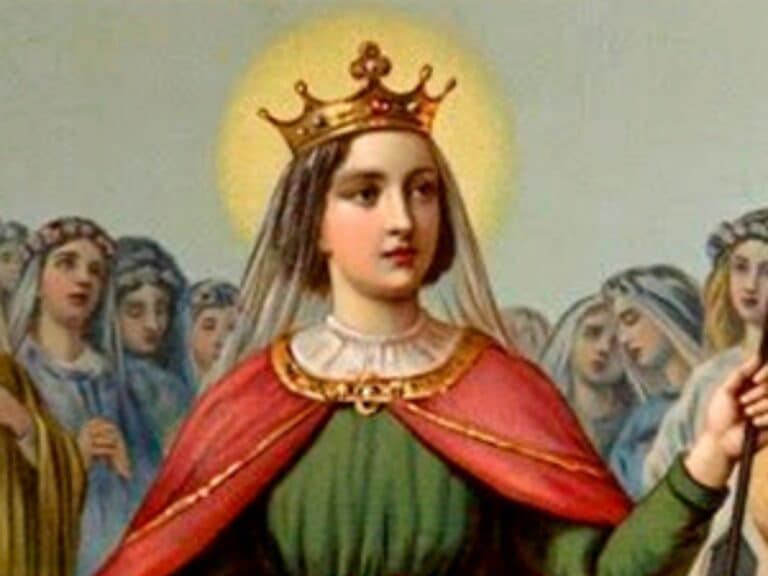
Saint Ursula was born in the year 362, in Cornubia, England. Daughter of the kings of the region, she was known for her beauty, which led several suitors to desire her in marriage. However, Úrsula had made a secret vow of total consecration to God.
Despite his desire to dedicate himself only to God, his father accepted the marriage proposal made by Duke Conanus, a pagan army general and family ally. This decision made Úrsula very sad, as she was a fervent follower of Christian principles.
Preparation for the Wedding
After receiving news of her marriage to a pagan, Úrsula wanted to refuse the proposal. However, according to the customs of the time, she needed to comply with her father’s decision. Thus, she asked for a period of three years to prepare for marriage.
During this time, Ursula hoped to convert General Conanus to Christianity or find a way to avoid marriage. Unfortunately, neither happened.
The Departure and the Tragedy
After three years of preparation, Ursula left for the wedding ceremony, accompanied by eleven young virgins, who were also destined to marry soldiers of Duke Conanus. Some reports suggest that the companions were eleven thousand virgins, but historical studies have revealed the veracity of only eleven.
During the ship journey, they sailed along the Rhine River and arrived in the city of Cologne, Germany. However, the city was occupied by the army of Attila, the king of the Huns. Unfortunately, all of the members of Úrsula’s entourage were killed except for her, who attracted Attila’s attention due to her beauty.
Attila tried to seduce Úrsula and proposed marriage, however, she refused, stating that she was already the wife of the most powerful of all kings, Jesus Christ. This enraged Attila, who personally beheaded Ursula on October 21, 383. The tomb of Saint Ursula and her companions is preserved in a church in Cologne.
The Company of Saint Ursula
During the Middle Ages, Italian Angela de Mérici founded the Company of Saint Ursula with the aim of providing Christian education to girls. Angela’s project aimed for these young women to become mothers who multiply the Gospel, catechizing their own children.
This initiative represented a significant advance at the time, since education was only aimed at men. According to the founder, the name of the order came from a vision she had.
Currently, the Ursuline Sisters, as the daughters of Saint Angela of Mérici are called, are present on all continents, keeping the memory of Saint Angela and Saint Ursula alive.
Conclusion
Saint Ursula was a courageous woman who decided to dedicate herself completely to God, even in the face of an unwanted marriage to a pagan. Her story inspired the creation of the Company of Saint Ursula, a religious order that seeks to educate girls and multiply Christian teachings.
Although she faced a tragic death at the hands of Attila, Ursula demonstrated her unshakable faith and rejected the King of the Huns’ proposals. She remained faithful to her vow of total consecration to God, becoming an example of strength and devotion for all.