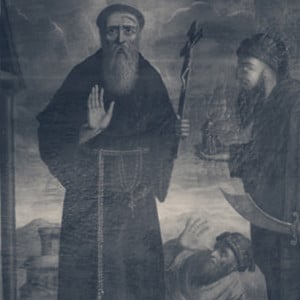
Saint Stephen Teodoro Cuénot
Saint Stephen Teodoro Cuénot was born in Réaumont, in Bélieu, in the year 1802. Son of a farmer, he was destined to become bishop and convert thousands of pagans from Indochina, all considered and loved as brothers. From an early age, Cuénot demonstrated an “aristocratic” nature combined with his closeness to the people and their miseries. His spirit was half evangelical and half revolutionary, characteristics that defined his path in life.
True Son of the People
Dom Estevão Teodoro Cuénot could easily be recognized as a true son of the people. For him, “neighbor” was not a generic expression or limited to a certain social class, country or historical period. His vision embraced men of all classes, races and nationalities, in a perennial revolution that is true Christianity.
Simple and peasant farming
Raised in a peasant family, whose baptism took place in a barn, Cuénot was educated by rural parish priests. To be able to maintain his studies, his peasant parents presented him with material assistance. However, there were times when even this was not enough and he had to drop out of school. Studying theology, to make him presentable, his mother sacrificed her wedding dress to make him a tunic. And the new priest’s first gesture was to present his mother with a new dress. This act exemplified his gratitude and generosity.
The Ideal Profile: Saint Stephen Teodoro Cuénot
Cuénot had a passion for watchmaking and wanted to patent his own perpetual motion mechanism. Furthermore, he was a catechist and teacher in the city group. In 1827, he joined the Missionary Fathers of Saint Vincent de Paul, upon passing through the door on Rue du Bac in Paris.
The following year, he became a missionary and left for Indochina, where he faced numerous difficulties. In 1835, he was consecrated Bishop of Metelópolis, coadjutor of what was then called Cochinchina. He was always a committed bishop, as Christians in Indochina were often subjected to harassment and persecution by Buddhist authorities. Despite this, Cuénot managed to convert thousands of people annually. Even those who abjured under torture often asked to be baptized.
The indigenous clergy tripled during the period that Cuénot was in Indochina. He dedicated himself to translating the sacred books, building churches and orphanages, in addition to reaching the distant mountainous regions of Laos with his preaching and example of Christian life. His exemplary performance contributed to the spread of the Catholic faith in the region.
A suffered and consummated martyrdom
In 1861, King Tu-Duc intensified the persecution of Christians in Indochina, and Bishop Cuénot was captured and locked in a narrow cage. Although he was not physically killed, he was slowly poisoned through disgusting indigenous “medicines”. Because of this cruel death, Saint Stephen Teodoro Cuénot is considered a martyr.
His captors, as much as they wanted to punish him, recognized the perfection of his soul. They then said that “he became perfect” and that heaven hastened to receive him without allowing him to suffer such torture. In reality, he was already dead when he was flogged and beheaded. A year after his death, a treaty between France and Indochina sanctioned freedom of worship, at least in theory.
Saint Stephen Teodoro Cuénot left a legacy of dedication to others, courage in the face of adversity and commitment to the expansion of Christianity. His life story is an inspiring example of faith and love for others, making him a venerated and revered saint.