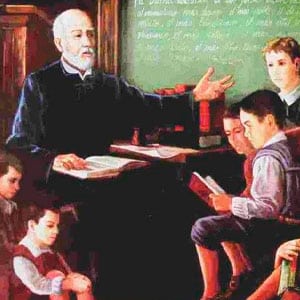
Saint Joseph of Calasanz
Saint Joseph of Calasanz was born on July 31, 1558, in the city of Aragon, Spain, into a noble and deeply religious family. His education was marked by strict respect for God's commandments, and from an early age, he had the desire to become a priest. However, his father wanted a military career for him, and young José's wishes were initially thwarted.
Despite his father's resistance, José managed to follow his vocation and was sent to study at the universities of Lleida and Valencia. After graduating, he received priestly ordination in 1583, although his father was not present at the ceremony. Soon, José became Vicar General of the diocese of Urgel.
In 1592, José traveled to Rome to resolve matters relating to the Holy See. At this time, he also served as tutor to the nephews of Cardinal Colonna, his longtime friend. While wandering the streets of the Eternal City, Joseph was shocked by the plight of the abandoned and helpless children who roamed the streets. He understood that his mission was to save these young people from the degradation to which they were condemned due to lack of adequate education.
From that moment on, José de Calasanz dedicated himself tirelessly to the education of poor young people. Initially, he faced difficulties in establishing his vision, but with the help of the parish priest of Santa Doroteia, in the Trastevere neighborhood, he managed to open the first free school in Europe for young people from the most disadvantaged social classes.
José believed that education was a fundamental right for everyone, especially the poor, and not just an act of charity, but an imperative of social justice. Thus, their schools were not limited to teaching the catechism, but aimed to offer complete training to students. He attracted other priests to share his teaching for free.
In 1612, José managed to acquire a building in Piazza Navona to accommodate the growing number of students attending his schools. In 1617, with the approval of the Pope, he founded the Pauline Congregation of the Poor of the Mother of God of the Pious Schools, later known as the Escolápios. In 1622, the Congregation became a Regular Order.
Despite his noble mission, José de Calasanz faced adversity. Society at the time recognized education and culture only as privileges of the wealthier classes, and José's work was the target of defamatory criticism from conservatives who wanted to maintain the status quo. He was denounced to the Holy Office, and his Order was reduced to the status of a Congregation of Secular Priests, subject to episcopal jurisdiction.
Despite the physical and spiritual trials he faced, José de Calasanz concluded his earthly life in 1648, without seeing the complete reconstitution of his Congregation. Only in 1699, their Constitutions were restored, and the Piarists resumed their solemn Vows, including the commitment to educating young people as their primary mission.
Today, Pious or Escolápia Schools are present in several countries, spreading the vision of Saint Joseph of Calasanz and offering education to thousands of young people around the world. His dedication to educating the poorest and his fight for children's rights made him an inspiring example of love for others and social justice. In 1767, Saint Joseph of Calasanz was canonized by Clement XIII and, in 1948, proclaimed “Universal Patron Saint of all Popular Christian Schools in the world” by Pope Pius XII. His life and legacy continue to influence generations, encouraging the appreciation of education as an instrument of transformation and hope for the less privileged.