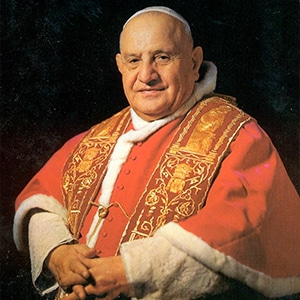
Saint John XXIII
Angelo Giuseppe Roncalli was born on November 25, 1881, in the city of Sotto il Monte, in the Province of Bergamo, Italy. His childhood was spent in a rural environment, in a humble family. In 1892, he entered the Bergamo seminary and, three years later, began writing his “spiritual notes”, which would later be published in the Giornale dell'anima.
Priesthood and pastoral experience
In 1900 Roncalli was sent to Rome to study theology, and in 1904 he was ordained a priest. He then returned to Bergamo, where he became secretary to Bishop Radini Tedeschi, remaining at his side until 1914. During this period, Roncalli absorbed Tedeschi's pastoral vivacity and reforming spirit.
After the experience of World War I, Roncalli became spiritual director at the local seminary. In 1921, he moved to Rome to take up the position of president of the central council of the Work for the propagation of the faith.
Patriarch of Venice and diplomatic career
In 1925, Roncalli was appointed by Pope Pius XI as apostolic visitor to Bulgaria, receiving episcopal ordination in the same year. He became apostolic delegate to Turkey and Greece in 1934, and in 1944 he was transferred to France, where he served as apostolic nuncio for eight years. In 1953, Roncalli was designated a cardinal by Pope Pius XII, and three days later he was named Patriarch of Venice.
The papacy of Saint John XXIII
After the death of Pope Pacelli, Roncalli participated in the Conclave in 1958 and, at the age of 77, was elected Pope on October 28. He chose the name John XXIII, symbolizing a transition to a new period after his predecessor's long pontificate.
John XXIII immediately demonstrated himself to be an innovative Pope. In 1959, he surprised everyone by announcing the convening of an ecumenical council, the Second Vatican Council, with the aim of reproposing the Catholic faith for the modern world. He also emphasized the importance of interreligious dialogue and the role of local episcopates. During his pontificate, John XXIII consolidated the internationalization of the college of cardinals.
The legacy of Saint John XXIII
John XXIII was known for his great humanity and dedication to the service of the Church. He sought to spread Christian charity and promote fraternal unity among peoples. His pontificate was marked by the convening of the Second Vatican Council, which had a significant impact on the life of the Catholic Church.
John XXIII died on June 3, 1963. In 2000, he was beatified by Pope John Paul II and, in 2014, he was canonized by Pope Francis. His pastoral dedication and desire to adapt the Church's message to the challenges of the contemporary world remain part of his lasting legacy.