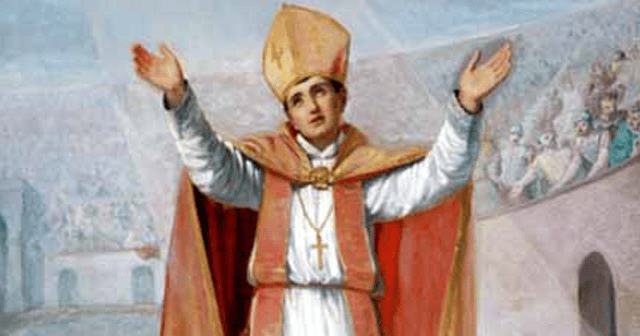
Saint Felix of Nola
Saint Felix of Nola , was Syrian by birth, and his father Hermias was a military man. He lived at Nola, five leagues from Naples, and had two sons: Hermias, who enlisted in the Emperor’s armies; and Felix, who served with all his heart the supreme Emperor and King of kings: Jesus Christ.
Saint Felix donated most of his assets to the poor and dedicated himself to serving the Church. Ordained a priest, he inspired everyone, both with the excellence of his doctrine and with the example of a holy and truly Christian life.
During his time, the Church was harshly persecuted by Decius (245-50) and Valerian (256). Imperial emissaries arrived in Nola to destroy the first columns of the Christian building.
At that time, the Bishop of Nola was Maximian, a holy, venerable, zealous and wise man, advanced in years. However, remembering the words that the Divine Master said to the Disciples “ when they persecute you in one city, flee to another ” (Mt 10, 73). He left Félix in front of his beloved church and left for hidden and safe places.
As they were unable to find the holy Bishop, the persecutors unleashed all their fury on Felix. First they used promises, and then threats and torment. As neither had any effect, they locked him in a dark prison, scattering pieces of tiles over the floor.
Saint Felix, imprisoned, was unable to satisfy the needs of the faithful. Maximiano was distressed and tried to return, but he couldn’t. Furthermore, in his old age, he suffered greatly from the cold and lack of food. But, just as happened with Saint Peter, the miracle of Felix’s release occurred, when a voice said: Follow me. The saint obeyed promptly and, shortly afterwards, an angel opened all the prison doors and gave him freedom, taking him to the mountain where Maximian was.
Saint Felix embraced Maximian and, seeing him in such a pitiful state, carried him on his shoulders to the house of a pious widow, where he recovered. After pious conversations, the two Saints decided to return to the city to the happiness and joy of the faithful.
For a short time they enjoyed tranquility, until the persecution flared up again, with even more fury. As soon as they arrived in the city, the Emperor’s emissaries sought out São Félix. He hid in the house of a pious woman, where he remained for about three months. When the storm passed, he went public and began to exhort the practice of virtue. The faithful looked at Félix as someone sent from heaven.
Around the same time, Bishop Maximiano died, a victim of age and too much work. Christians immediately thought of Felix to succeed him, but he refused the appointment as Bishop. He lived in poverty.
Saint Felix, finally, after edifying everyone with an exemplary life, full of years, but even more of virtues and merits, died in the era of 256.