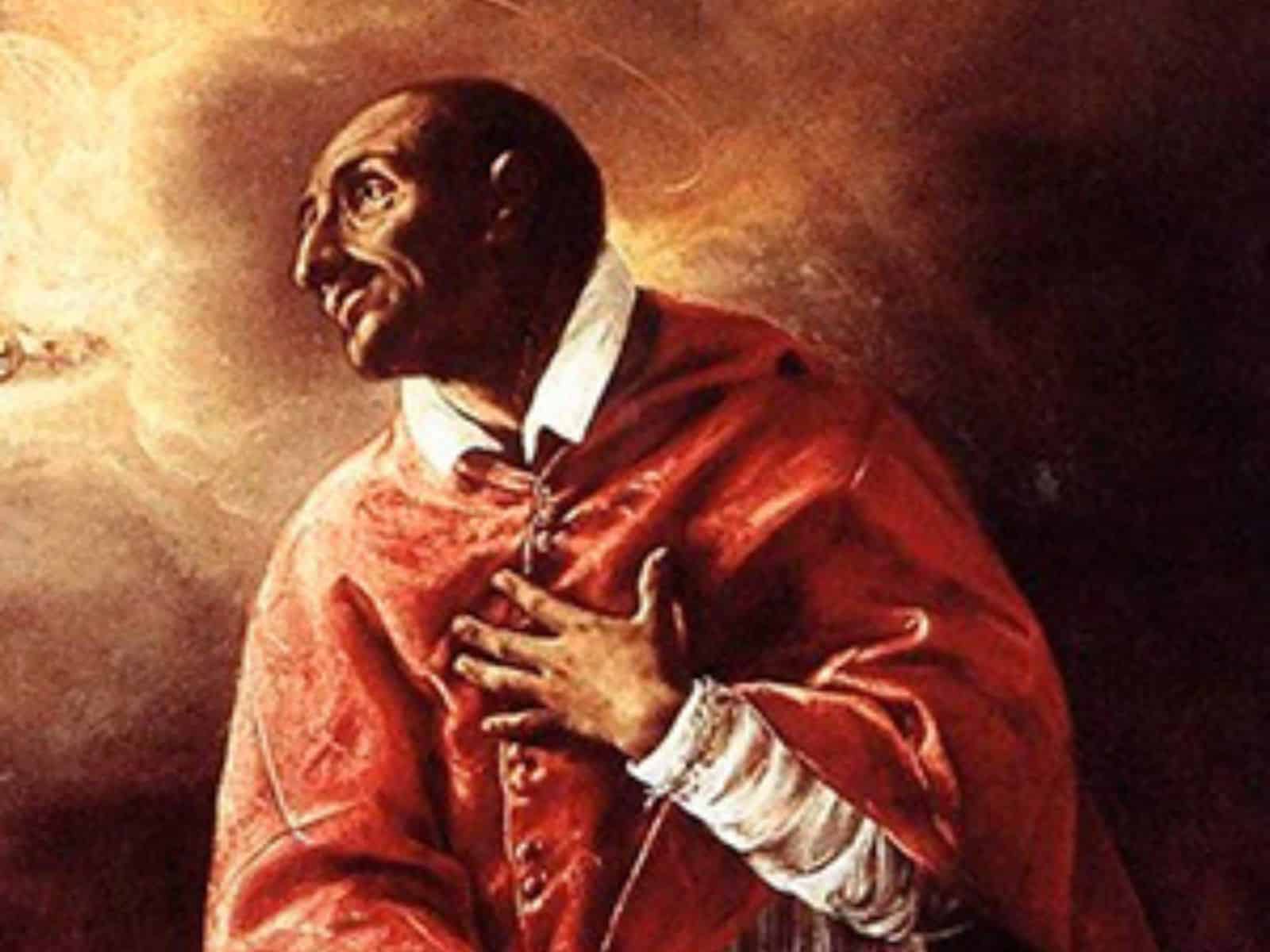
Saint Charles Borromeo
Carlos, of the illustrious Borromean family, was born on October 2, 1538, in Arona, Italy. The boy revealed great talent and rare intelligence. Alongside these qualities, he manifested a strong inclination towards religious life, piety and the fear of God. Even as a child, he already demonstrated his priestly vocation, building tiny altars and imitating the priestly functions he observed in the Church. His love of prayer and his dislike of profane entertainment were clear signs of his future trajectory as a religious man.
The Priesthood and the Reorganization of the Catholic Church
In 1562, Carlos was ordained a priest and soon afterwards consecrated Bishop. At just 27 years old, he assumed the position of Archbishop of Milan. From a very young age, Carlos already had grandiose plans for the reorganization of the Catholic Church, especially concluding the Council of Trent, which was essential for the renewal of religious life. Carlos persisted in drawing the attention of his uncle, who was a Cardinal and was elected Pope, to the importance of this conclusion. Finally, the Council took place and Carlos was one of the first to carry out its orders, even if this meant leaving a superior position to occupy an inferior one.
Saint Charles Borromeo: Gift of Charity
Saint Charles was fully aware that charity opens hearts to religion. He reserved a large part of his personal income to help the poor, distributing inheritances and income among the disadvantaged. His charitable actions went further, especially during difficult times experienced by the city of Milan, such as hunger and epidemics. In 1569-1570, during a great famine and a plague-like epidemic, Charles even begged for alms for the poor, creating sources of aid at a time when all other sources had been exhausted. In the face of the plague that struck the city in 1576, he consoled the abandoned sick and offered them the holy sacraments. Carlos used all the resources he had to alleviate the suffering of the sick, including the use of his own life. More than a hundred priests had lost their lives during the epidemic. The Archbishop took the opportunity to rebuke the rich who forgot God.
Meeting with the Pope and Recognition
Despite the difficulties he faced and the hostilities he suffered, Charles Borromeo received recognition from Pope Gregory XIII, who welcomed him to Rome with great distinction. His gesture was a response to the attacks and unfounded accusations made against the Archbishop. Even the governor of Milan, who had encouraged hostilities against Charles, recognized his error on his deathbed and counted on the assistance of the holy Bishop in his hour of agony. This governor’s successor, Charles of Aragon, Duke of Newfoundland, maintained a peaceful relationship with ecclesiastical authority. Carlos Borromeu’s life marked by kindness and charity came to an end in October 1584, when he died at the age of 46.
Easter
Charles Borromeo was beatified in 1602 by Clement VIII and canonized in 1610 by Paul V. His influence on the reform of the Church can be seen in several countries, where the reform followed the example of Milan, based on the principles of the Council of Trent. His remains rest in the Crypt of Milan Cathedral, in an “Urn” covered with silver panels that describe his life.
From the “boy bishop” to the “giant of holiness”
The life of Saint Charles Borromeo was marked by his rapid rise in the church. At the age of 12, he already had an honorary title and a considerable income, but he chose to dedicate his assets to charity for the poor. He studied Canon Law and Civil Law, and at the age of 25 he was ordained a priest and consecrated Bishop. He became one of the main promoters of the reform of the Church during the Council of Trent, and at the age of 27 he assumed the position of Archbishop of Milan. His pastoral action was guided by the love of Christ and the intention of renewing the Church from within. He faced hostility and resistance, but he never stopped defending the Church and reforming its structures. His dedication to the Ambrosian Church was total, carrying out pastoral visits, founding seminaries, building churches, schools, colleges and hospitals. Saint Charles Borromeo was also responsible for bringing the Shroud from Turin to Italy, where he made a pilgrimage on foot to pray in front of the relic. His weakened physique and poor health did not prevent him from helping the sick during an epidemic in Milan, which became known as the “plague of Saint Charles”. His life of kindness and charity was recognized by the Pope, who received him with distinction in Rome, and by his own governor of Milan, who recognized his mistakes on his deathbed. Saint Charles Borromeo passed away at the age of 46, leaving a moral and spiritual legacy that continues to this day.