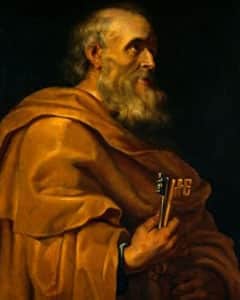
Saint Callixtus I
Saint Callixtus I , also known as Roman of Trastevere , was an important Pope of the Catholic Church. Originally from a family of slaves, Callisto had a difficult life, but was able to overcome his difficulties and become an influential figure within the Christian community. He is buried in the church of Santa Maria, in Trastevere, a place of great importance for the Catholic faithful.
An Unskilled Administrator Who Paid for His Mistakes
As a Christian, Callisto was entrusted with the administration of the assets of the Christian community by his compatriot Carpophorus, who was part of the family of Emperor Commodus. However, Callisto did not prove to be a skillful administrator and was eventually discovered to be involved in a major embezzlement. To escape the consequences of his actions, he fled to Ostia, where he was captured before he could leave.
Justice Against Callisto
Captured at Ostia, Callisto was condemned to pay for his embezzlement by turning a mill wheel. Thanks to Carpophorus's generosity, he had the opportunity to pay off his debt, but justice took its course and Callisto was condemned to flagellation and deported to the mines of Sardinia.
A Man Who Found Freedom
After being released from deportation, Callisto caught the attention of Pope Victor, who personally showed interest in him. This fact indicates that, despite his failures as an administrator, Callisto already enjoyed a certain fame within the Christian community. To keep him away from temptations, Pope Victor gave him a salary. His successor, Pope Zeferinus, was also generous and ordained him a deacon, in addition to entrusting him with the custody of the Christian cemetery on the Ancient Appian Way, which became known as the catacombs of Saint Callixtus.
Mission in Church Cemeteries
Pope Zeferinus called Callisto back to Rome to take care of the Church's cemeteries. It was then that the excavation of the large cemetery along the Appian Way, named after Saint Callixtus, began. His role as guardian of this place was fundamental to the development of the Catholic Church at the time.
Elected Pope and Condemned for Heresy
After the death of Zeferinus, Callisto was elected Pope. However, his pontificate was not easy, as he faced opposition from some members of the Christian community in Rome. Falsely accused of heresy, Callisto was the target of attacks from antipopes and dissidents. Information about his life is presented in a biased way, portraying him as a former slave and fraudster.
The Martyrdom of Saint Callixtus
Despite the adversities, Saint Callisto crowned his life as a true martyr. Following the safest tradition, he was martyred during a popular revolt against Christians and thrown into a well. Later, he was honored with a burial in the Calepódio Cemetery, on Via Aurélia, close to the place of his martyrdom. That is why he was not buried in the great necropolis that he helped to expand, where other Popes, such as Saint Zeferinus, were later buried, in the part known as the Crypt of the Popes.
The Legacy of Saint Callixtus I: The Construction of the Crypt
One of the most visited attractions by pilgrims and tourists in Rome are the catacombs, especially those of Saint Callixtus, which were defined as the most respectable and famous by Pope John XXIII. With an area of more than 120,000 m² and around 20 kilometers of corridors, the catacombs forever fix the memory of Saint Callixtus, who played a fundamental role in the construction of this place while he was deacon of Pope Zeferino and later as Pope. Furthermore, many martyrs were buried there, including Pope Pontian, Antero and Fabian.
The Basilica of Santa Maria in Trastevere
The tomb of Saint Callixtus is located in the basilica of Santa Maria in Trastevere, in the heart of ancient Rome. This church, built by order of Pope Julius in the 4th century, is also known as Saint Callisto. Here, the memory of this important Pope is celebrated and his influence on the Christian community is remembered.