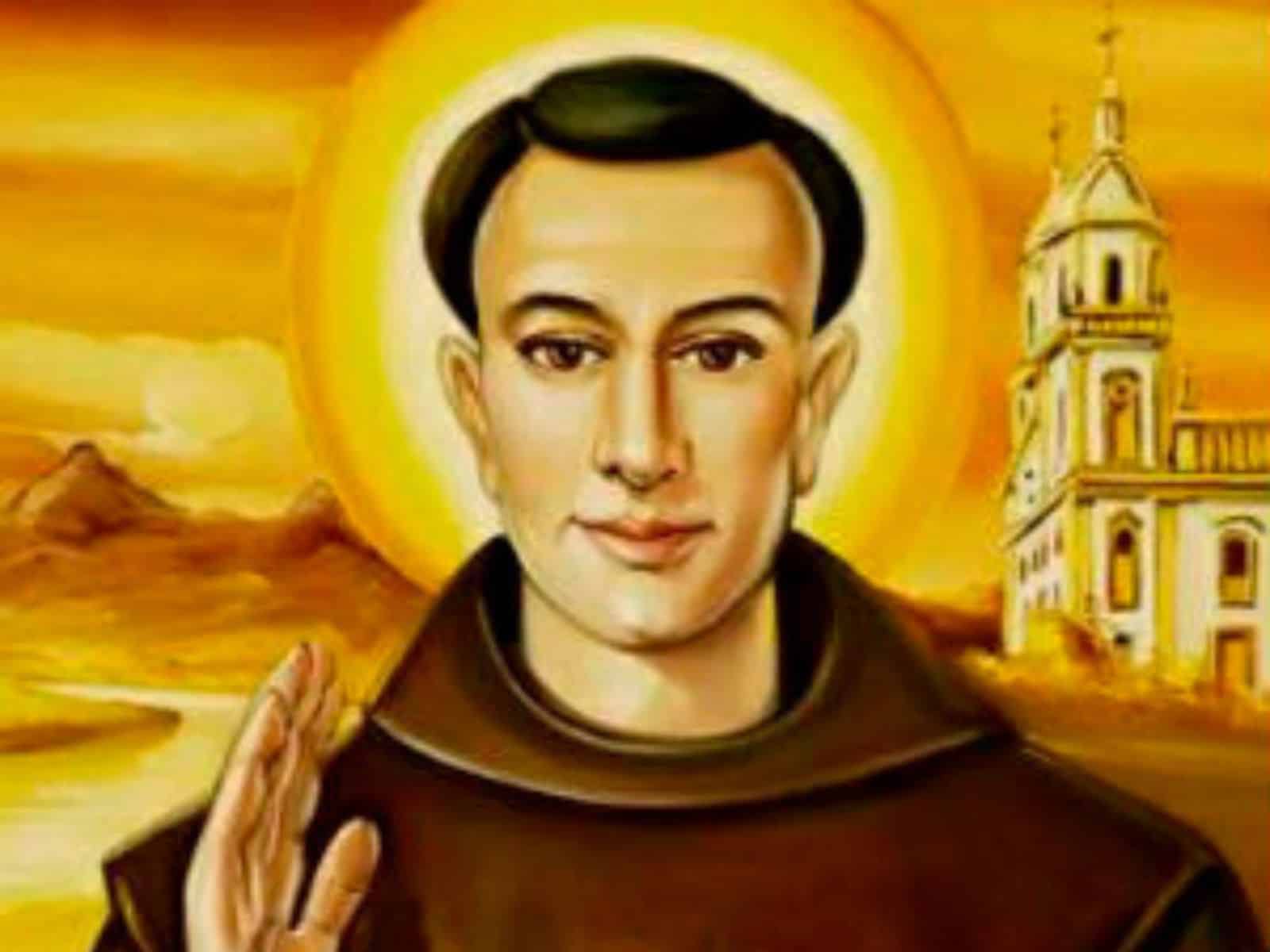
Saint Anthony of SantAnna Galvão (Frei Galvão)
Frei Antônio de Sant’Anna Galvão, known as Frei Galvão, was born on May 10, 1739, in the city of Guaratinguetá, in the Paraíba Valley, in the State of São Paulo. He was born into a very religious, rich and noble family, being the fourth of ten children. His father, Antônio Galvão de França, was a merchant and belonged to the Franciscan Third Order. His mother was called Isabel Leite de Barros.
Adolescence and Devotion to Saint Anne
At the age of 13, Frei Galvão was sent by his parents to study human sciences at the Jesuit seminary Colégio de Belém, in Cachoeira, Bahia. During his four years of studies there, he excelled in the areas of building construction and Christian practice. It was at this time that he received the sad news of his mother’s premature death, which led him to adopt Sant’Ana as his spiritual mother, changing his name to “Frei Antônio de Sant’Anna Galvão”.
The Franciscan Life
After completing his studies, Frei Galvão joined the Franciscan Order, at the Macacu convent, in Itaboraí, Rio de Janeiro. On July 11, 1762, he was ordained a priest and transferred to the Convent of São Francisco, in the city of São Paulo, where he continued his studies in philosophy and theology.
The “New Splendor of the Convent”
In 1768, Frei Galvão was appointed confessor, preacher and porter of the convent, being recognized for his dedication and talent in these positions. Such was its prominence that the São Paulo City Council gave it the title of “the new splendor of the Convent”. In 1770, he was invited to join the Academia Paulistana de Letras due to his poetic skills in Latin.
The Foundation of Recolhimento Nossa Senhora da Luz
In 1769, Frei Galvão was appointed to be a confessor at the Recolhimento de Santa Teresa, in São Paulo, where he met Sister Helena Maria do Espírito Santo. She said she received a request from Jesus: the founding of a new Recollection. Even at a time when the construction of convents and churches was prohibited, Frei Galvão decided to take over the foundation of Recolhimento Nossa Senhora da Luz. The construction took 28 years to be completed and gave rise to Bairro da Luz in São Paulo.
The Master of Novices and the Miracle Pills
Frei Galvão was unjustly arrested when defending a man, but the people and the Bishop of São Paulo interceded for his freedom. In 1781, he was appointed master of novices in Macacu, and in 1798 he assumed the position of guardian of the Convent of São Francisco. In 1811, he founded the Convent of Santa Clara in Sorocaba.
In addition to his religious activities, Frei Galvão stood out for his prayer life and the mystical phenomena he witnessed. He had abilities such as the gift of healing, the gift of science, bilocation and levitation, always using these gifts to help the sick and needy.
Frei Galvão’s Pills
Frei Galvão became known for the famous miracle pills he distributed. On one occasion, faced with the impossibility of praying for a sick person, he wrote a phrase from Our Lady’s office on a small piece of paper and turned it into a pill. When taken in prayer, the pill resulted in the patient’s healing. The fame of the pills spread quickly, and Frei Galvão began to bless and distribute these pills to the people, with countless testimonies of graces achieved through them being reported.
Canonization and Legacy
Frei Galvão died at the Mosteiro da Luz on December 23, 1822, a few months after Brazil’s independence. His reputation for holiness was such that a crowd gathered to say goodbye to the saint. In 1998, he was beatified by Pope John Paul II and, in 2007, he was canonized by Benedict XVI, becoming the first Brazilian saint. His life of dedication to faith, works of charity and his legacy of miracles and graces achieved make Frei Galvão an example of holiness and devotion in Brazil.