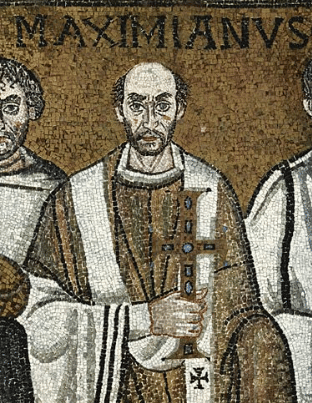
Saint Maximian of Ravenna, bishop
Saint Maximian of Ravenna, also known as Maximius of Pola, was born in the city of Pola, in Istria, currently located in Croatia. He was consecrated bishop of Ravenna in 546 by Pope Vigilius, in Patras, Greece. The religious, who was already a 48-year-old deacon of Pola, became the 26th bishop of the Italian city. Maximian's congregation initially refused his leadership because he was chosen by Emperor Justinian I, and was not his initial candidate.
Modern art historian Meyer Shapiro cited Maximian as “a poor deacon of Pola who achieved high position through his political prowess.” Although the people of Ravenna did not want to accept him as archbishop, he was able to overcome resistance with cunning maneuver, gaining recognition for his discretion, generosity and great actions in building and decorating the church.
Maximian of Ravenna: his works
During his lifetime, Maximian contributed significantly to the religious culture of Italy. He completed the Basilica of Saint Vital in Ravenna, as well as building the Basilica of Saint Apollinaris in Classe and other churches. The religious dedicated himself to revising liturgical books and correcting the Latin text of the Bible, also commissioning several illuminated manuscripts. Furthermore, for the main altar in Ravenna, he ordered the making of a curtain made from the most expensive cloth, embroidered with images from the life of Jesus, and another with the portraits of all his predecessors embroidered in gold. One of Maximian's most notable episcopal furniture is the Throne of Maximian, a chair made entirely of ivory engravings, probably produced in Constantinople, capital of the Byzantine Empire.
In a sixth-century mosaic in the Basilica of Saint Vital, Maximian appears with Justinian and his entourage holding an eggnog cross and wearing what may be considered early versions of an alb, chasuble, and pallium. For his notable contribution to the culture of Italy, Maximian is recognized as a saint by the Catholic and Orthodox Church, even having a church dedicated to him in Ravenna.