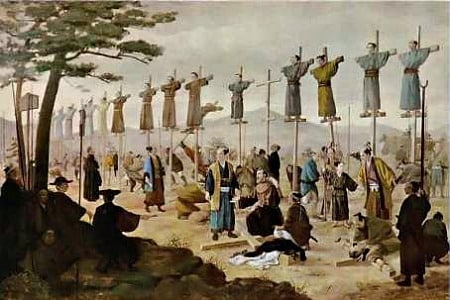
São Paulo Miki and companions
Saint Paul Míki was the first Japanese martyr and the first religious man of Japanese origin. According to tradition, he received religion through his family who had received evangelization from Saint Francis Xavier. Thus, he became a Jesuit, even though he wanted to be a priest, he was unable to be ordained due to the lack of a local bishop. His work of evangelization and dialogue with Buddhists was carried out throughout the country.
Persecution against Christians
In 1596, Shogun Hideyoshi, a samurai military, began a major persecution against Christians due to divergences in missionary orders and the behavior of some foreign Christians. Saint Paul Míki was arrested along with 6 Franciscan friars, 3 Jesuits and 17 lay converts, including 2 very young boys.
Martyrdom of the 26
On February 5, 1597, on Mount Tateyama in Nagasaki, 26 people were nailed to the cross and killed. Among them were: religious from the Society of Jesus, João de Goto Soan, Tiago Kisai and another unknown; priests of the Order of Friars Minor, Pedro Baptista Blásquez, Martinho da Ascensão Aguirre, Francisco Blanco, Filipe de Jesus de las Casas, Gonçalo Garcia, Francisco de São Miguel de la Parilla; lay catechists, Leão Karasuma, Pedro Sukejiro, Cosme Takeya, Paulo Ibaraki, Tomé Dangi, Paulo Suzuki; neophytes, Luís Ibaraki, António, Miguel Kozaki and Tomé, his son, Boaventura, Gabriel, João Kinuya, Matias, Francisco de Meako, Joaquim Sakakibara, Francisco Adaucto.
Canonization of the Martyrs
Paulo Miki and his companions were canonized on June 8, 1627, by Pope Pius IX. In those years of canonization, the martyrdom was narrated in a book that served as inspiration for the missionary work of a Venetian seminarian, Daniel Comboni, future great apostle of “Africa”. Pope Benedict XVI, when he was a cardinal, stated that reports of the martyrdom of the first Japanese Christians brought “enormous certainty and serene joy” (February 6, 1991) .
Museum of Martyrs
Currently, there is a museum dedicated to the martyrs in the city of Nagasaki. It contains Luís Fróis' book on the account of the martyrdom of the 26 Christians, from February 1597, letters from Saint Francis Xavier and other historical artifacts. In addition, there is a bronze sculpture and the Ôura Cathedral, dedicated to the martyrs and heritage of the National Treasury of Japan, one of the oldest churches in the country.
References :
– https://www.geracaoalternativa.com.br/entenda-o-martirio-de-sao-paulo-miki-no-japao/
– https://www.al.sp.gov.br/noticia-131905/sao-paulo-miki-e-seus-pessoas-os- Primeiros-martires-japoneses/