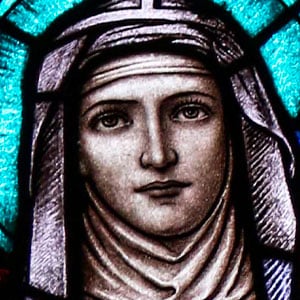
Santa Brigida, abbess
Saint Bridget: Patroness of Sweden and Copadroness of Europe
Canonized in 1391 by Boniface IX, Saint Bridget is the patron saint of Sweden. In 1999, she was also declared co-patron saint of Europe by Saint John Paul II. Brígida was born into an aristocratic family and, from a young age, had a decisive character. Despite feeling a religious vocation, she accepted marriage with Ulf, the governor of a district in the Kingdom of Sweden, at her father's request.
Eight children were born from this union, including Catherine, who was also canonized. Together, they adopted the Franciscan Tertiary Rule and founded a small hospital.
Guided by a religious scholar, Bridget studied the Bible and was appreciated for her pedagogy, being summoned by the king of Sweden to guide the young queen to Swedish culture.
After 20 years of marriage, her husband died and she decided to divest herself of her possessions and live in the Cistercian monastery of Alvastra. Here, his new mission began. In 1349, Brigid went to Rome to obtain recognition for her Order, dedicated to the Holy Savior, and established herself in the Eternal City, in a house in Farnese Square.
Brígida's mission and her commitment to Peace in Europe
The highlight of Brígida's mission – as well as that of Santa Catarina da Sena – was to ask the Pope to return to Peter's tomb. Although Pope Urban V returned for a brief period, Gregory XI established himself only a few years after Saint Bridget's death.
Another “aspect” of his strong commitment was peace in Europe. At that time, her charitable works were decisive and she lived in poverty, to the point of begging at the doors of churches. Furthermore, he made several pilgrimages, even to the Holy Land.
The central point of his experience of faith was the Passion of Christ, as well as the Virgin Mary. Witnesses to this were the “Brigidino Rosary” and the prayers, linked to the particular graces promised by Jesus to her. Saint John Paul II highlighted: “The Church, without pronouncing itself on each of the revelations, accepted the authenticity of the set of her interior experiences”.
The figure of Saint Bridget was much loved by recent Popes. Benedict XVI, for example, dedicated a catechesis during the General Audience.
Pope Francis wanted to canonize the one who, in the 20th century, had renewed the Order of the Most Holy Savior, Maria Elizabeth Hesselblad, giving it a strong ecumenical impulse, always with a view to the search for peace and unity, so dear to Bridget.