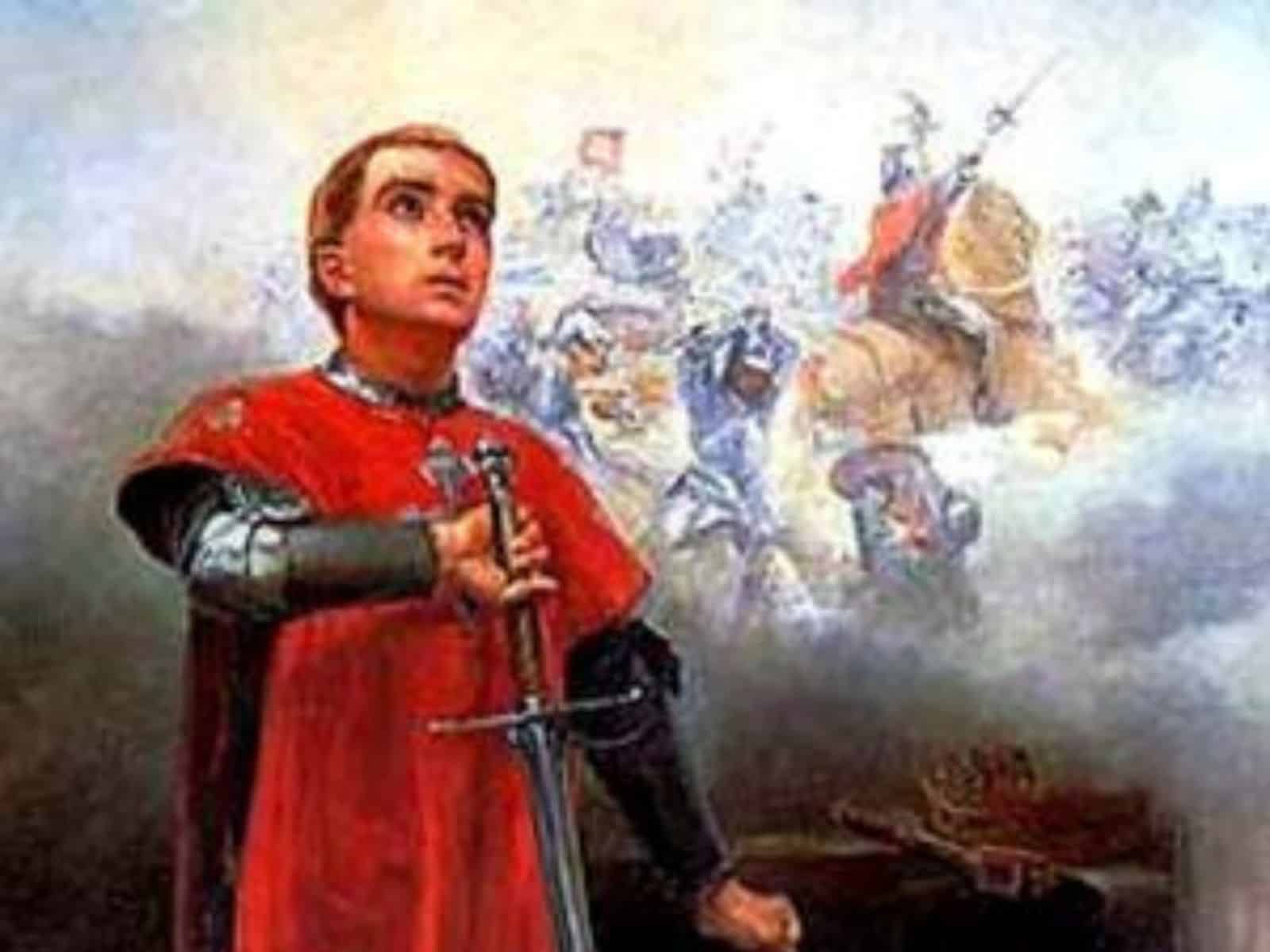
Saint Nuno of Saint Mary
Saint Nuno of Saint Mary, also known as Nuno Álvares Pereira, was born in Portugal on June 24, 1360. Son of the knight of the Hospitallers, Álvaro Gonçalves Pereira, he received a chivalric education, which was typical of the children of noble families at the time.
Youth and Marriage of Saint Saint Nuno of Saint Mary
At the age of thirteen, Nuno became a page of Queen D. Leonor and, shortly afterwards, he was knighted, being well received at Court. In 1376, at the age of 16, he married D. Leonor de Alvim, a rich young woman and widow, by his father’s wishes. Three children were born from this union, two of whom died young and the third, Beatriz, married the son of King D. João I, becoming the first Duchess of Bragança.
The Constable by D. João I and his Victories
In 1383, after the death of King D. Fernando, the Lusitanian crown was being disputed by the king of Castile, who had married the late king’s daughter. Thus, his brother D. João, Master of Avis, entered the fight for the crown and Nuno took his side, becoming the Constable, the supreme commander of the army. Under Nuno’s leadership, the Portuguese army achieved several victories, the most notable being the battle of Aljubarrota, on August 14, 1385, which ended the conflict.
Spirituality and Military Skills of São Nuno de Santa Maria
Despite being recognized for his military skills, São Nuno also had a deep spirituality. His life was marked by the love of the Eucharist and the Virgin Mary, which were the basis of his inner life. The banner he chose bore the images of the Crucified One, Mary and the knights of Saint James and Saint George. Furthermore, he built churches and monasteries, such as Carmo de Lisboa and the Church of Santa Maria da Vitória.
The Religious Life of Saint Nuno de Santa Maria
After his wife’s death in 1387, Nuno refused to remarry and became an example of purity of life. He distributed most of his assets among his former battle companions and, in 1423, decided to enter the Carmelite convent he founded, adopting the name Friar Nuno de Santa Maria.
The Abandonment of Arms and Privileges
Driven by his love for God, Saint Nuno abandoned his weapons and power to dedicate himself entirely to religious life, in accordance with the Rule of Mount Carmel. He gave up all the privileges he had as Constable of Portugal to assume the humble status of a friar dedicated to the service of the Lord, Mary and the poor, whom he saw as Jesus himself.
His Death and Canonization
Saint Nuno of Saint Mary died at the age of 71, on Easter Sunday, April 1, 1431. Soon after his death, the people began to call him “Saint Constable” and he was acclaimed as a saint. He was beatified on January 23, 1918 by Pope Benedict XV and canonized on April 26, 2009 by Pope Benedict XVI.
Saint Nuno of Saint Mary, with his military skills and deep spirituality, demonstrated the balance between military life and religious life. He is an example of holiness for Christians and an important figure in the history of Portugal. His devotion to the Eucharist and the Virgin Mary, as well as his humble service to those most in need, continue to inspire many people around the world.