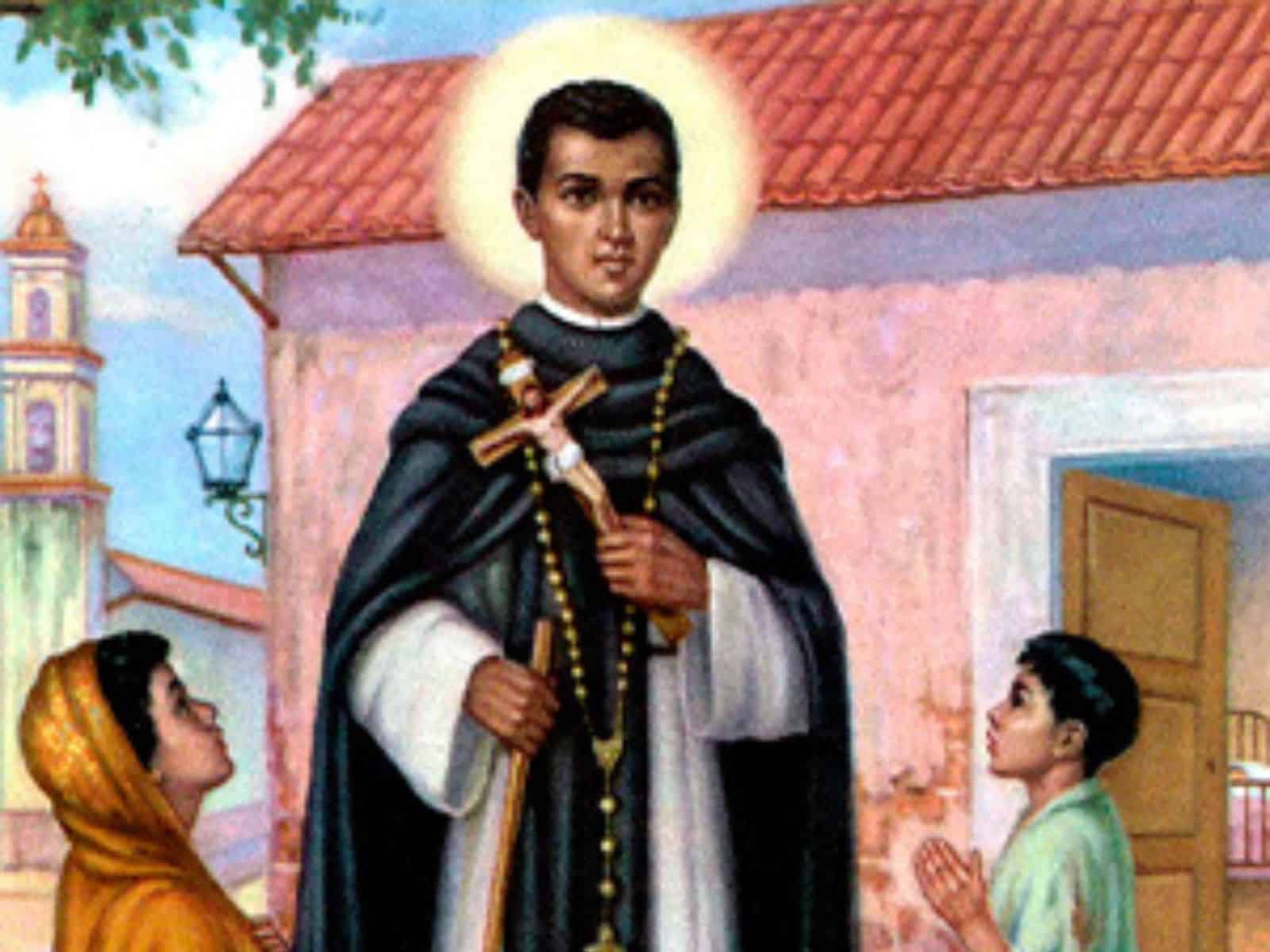
Saint Martin of Lima
Saint Martin of Lima was born on December 9, 1579, in the city of Lima, Peru. Son of a Spanish nobleman, João Porres, and a black woman from Panama, of African origin called Ana Velásquez. Due to his dark skin, his father did not recognize him as a legitimate son and he was recorded in the baptism book as the son of an unknown father.
The simple life of Saint Martin
From an early age, Saint Martin lived in conditions of poverty. Raised by his mother, who educated him in the fear of God, he began working as a barber’s apprentice when he was still a child. Although the profession of barber was despised by those who sought nobility, at that time this profession also involved the tasks of dentist and surgeon.
Saint Martin transformed his profession into an act of charity towards the poor, especially after becoming a doctor’s assistant.
Entrance to the convent
At the age of 15, Saint Martin decided to abandon everything and entered the Dominican convent in Lima. However, he was admitted only as a tertiary and was given the most menial tasks in the community. Although his role was humble, his spiritual life was profound. The superiors of the convent realized his value and, on June 2, 1603, he was admitted to solemn profession as a full member of the Order.
Solicitude for brothers and extraordinary deeds
Saint Martin showed great concern for his sick brothers, taking care of them even when the infirmary door was locked. He considered himself a slave to everyone and his devotion grew when a brother he cared for got worse.
Furthermore, Saint Martin was endowed with extraordinary charismas, such as prophecies, ecstasies and bilocations. Although he never left Lima, he was seen in as far away as Africa, China, and Japan to comfort missionaries in distress. His humility and holiness made him a reference for theologians, bishops and civil authorities. Even the viceroy had to wait in front of his cell because Saint Martin was in ecstasy.
From the humility of the convent to holiness
During a plague epidemic, Saint Martin cured the people who came to him and also his sixty fellow convents. He dedicated his life to the poor, begging to help them. With the alms he got, he founded a hospital for abandoned children and fasted to feed those in need. Saint Martin fasted throughout the year, eating only leftover bread, but discreetly, so that no one would notice. His actions were accompanied by the prayers he prayed during the night, following the example of Jesus (Luke 6:12).
Thus, even without performing extraordinary feats, Saint Martin achieved a high degree of holiness through the constant practice of charity.
Easter
Saint Martin died on November 3, 1639, at the age of 60, in Lima. Immediately after his death, he was honored and venerated as a saint. He was beatified by Pope Gregory XVI in 1837, canonized by Saint John XXIII on May 6, 1962, and proclaimed patron of barbers by Pope Saint Paul VI in 1966.
Saint Martin’s example of love and service
The Convent of Our Lady of the Rosary, where Saint Martin lived, housed around 100 Dominican friars at the end of the 16th century. They were facing financial problems and, at a certain point, the prior decided to sell some precious objects to pay the debts. However, Saint Martin, a young mulatto responsible for the most menial tasks, offered to be sold as a slave instead of the objects. The prior, deeply moved, ordered the young man to return, recognizing the value he had even though he was considered invisible by the community.
The example of Saint Martin shows that skin color or social status do not determine a person’s value. He stood out not only for his skill as a barber, but also for his devotion and charity. Saint Martin was known for his ability to transmit the Gospel to the poor and help those in need. His exemplary life should be remembered as an example of love and service to those most in need.