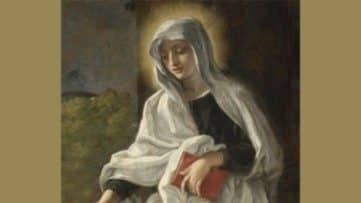
Blessed Ludovica Albertoni
“In the past, I was more of my husband than of myself, without being able to dedicate myself to you, Jesus. Now, living only for myself, I go from being mine to being completely yours.”
It is not always easy to belong to a noble family: of course survival is guaranteed, but there are obligations, sometimes very onerous, that one must submit to. This Ludovica knew very well.
Born in 1474, she was the daughter of the Roman patrician, Estêvão Albertoni, and Lucrécia Tebaldi. Upon reaching adulthood, he had to renounce his vocation to get married, as per his family's wishes.
Prayer as a school of life
But let's go in order. Ludovica was left fatherless when she was just two years old. Her mother remarried, but she was raised by her grandmother and some aunts, who gave her a cultural and Catholic education.
At the age of 20, Ludovica had to marry, against her will, the nobleman from the Roman district of Trastevere, Tiago de Cetera, of rude and unstable character. Nevertheless, the young woman was a faithful wife and bore him three daughters.
Hugging “Lady Poverty”
At the age of 32, however, Ludovica became a widow. When she won the dispute with her brother-in-law over her husband's inheritance, she distributed the goods among her daughters and offered her entire share and herself to the poor.
For a long time, she attended the nearby church of São Francisco de Ripa and was guided, on her spiritual path, by the Friars Minor, who accompanied her in her decision to become a Franciscan Tertiary.
Following in the footsteps of the Poor Man of Assisi, Ludovica dedicated herself, in particular, to taking young women off the streets and out of ignorance, educating them personally and teaching them an honest profession with which to support themselves.
In 1527, during the Sack of Rome by the Lanzichenecchi, she spared no effort to help the Roman people, even opening the doors of her home to them, which led to her receiving the title “Mother of the Poor”.
The devotion of the Romans
Ludovica died at the age of 60 and was buried, according to her wishes, in the Chapel of Santana, in the church of San Francisco de Ripa, in Trastevere. There, she was immediately venerated by the Romans, who knew her reputation for kindness, but also the episodes of ecstasy and levitation that the Lord wanted to give her in life.
Precisely as a mystic, the artist, Gian Lorenzo Bernini, dedicated a famous statue to her, a masterpiece of Baroque sculpture.
Ludovica Albertoni was beatified by Pope Clement X in 1671 and is venerated as co-patron saint of Rome.