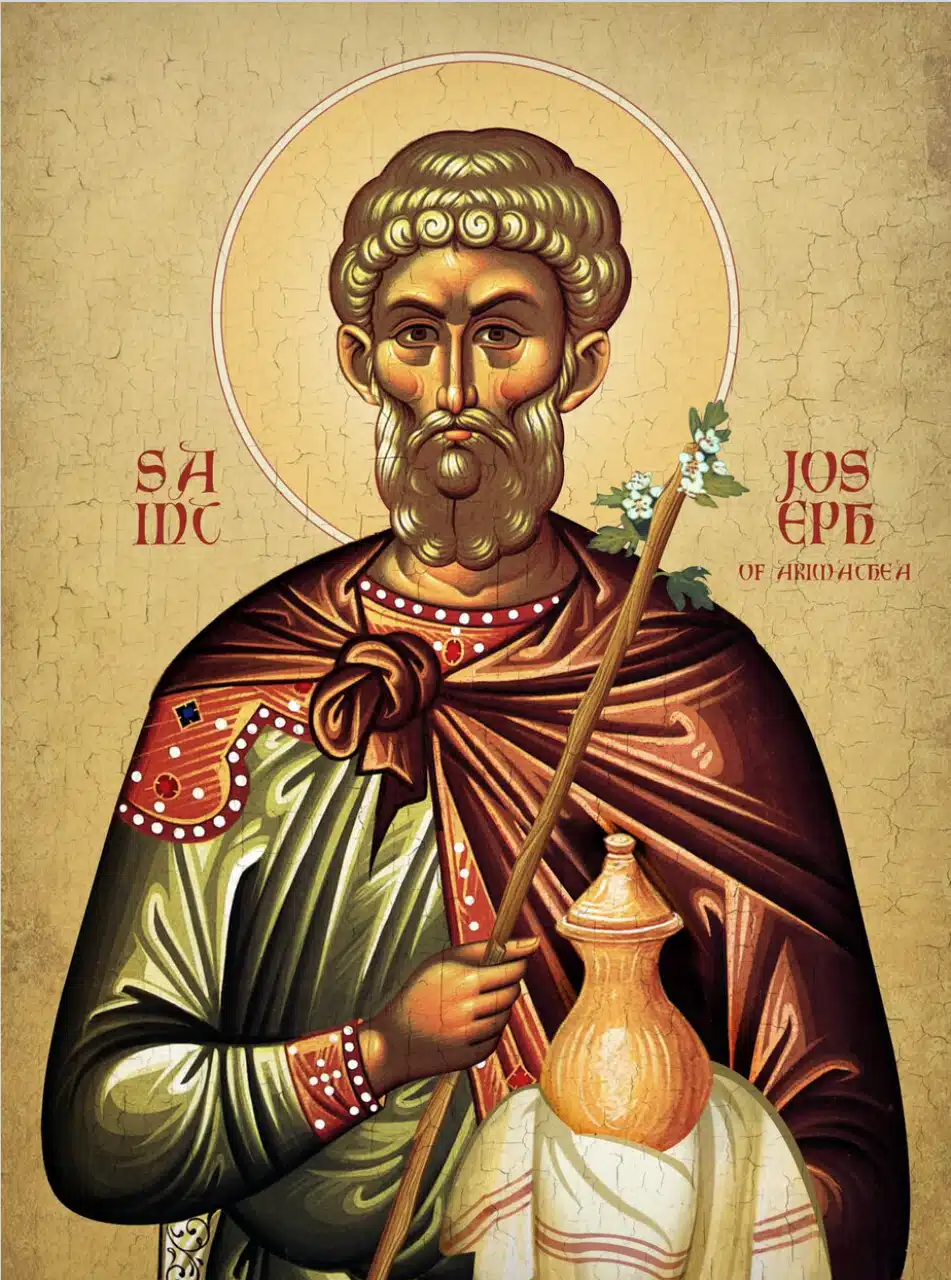
Saint Joseph of Arimathea
Saint Joseph of Arimathea, a well-known figure from the canonical Gospels, has his story shrouded in mystery and legend. An illustrious member of the Sanhedrin, a powerful and esteemed man in Jerusalem, his hometown was probably Arimathea, identified as modern-day Rantis. His quiet participation as a disciple of Jesus changed dramatically when, after the crucifixion, he asked Pilate for Christ's body and buried it in his own tomb.
The Illustrious Member of the Sanhedrin
Joseph of Arimathea is presented in the Gospels as an illustrious member of the Sanhedrin, the Jewish supreme council. A powerful and esteemed man in Jerusalem, he watched Jesus in silence, afraid of the criticism he might face for his interest in the Messiah. However, his discreet stance changed drastically after Jesus' crucifixion.
The Courageous Request
Despite the risks, Joseph of Arimathea did not hesitate to ask Pilate for the body of Christ, using all his power to obtain permission for the burial. His boldness in openly assuming his faith is highlighted, since, by offering his own tomb to Jesus, he demonstrated devotion and compassion even in the face of the threat of tragic consequences.
History Beyond the Gospels
After Easter, Joseph of Arimathea is no longer mentioned in the canonical Gospels, but stories arose around his figure, especially in traditions of Eastern origin. Some of them suggest that he set out to evangelize all of Europe, including Britain, where he was associated with the King Arthur literary cycle as the guardian of the Holy Grail.
The Fantastic Legends
As the legends developed over the centuries, they acquired fanciful and often implausible contours. Some apocryphal works, such as the “Acts of Pilate” or the “Gospel of Nicodemus”, report imaginary episodes involving Joseph of Arimathea, stating that he was arrested by the Jews due to his support for Jesus.
The Importance of the First Disciples
Although the legends lack historical foundation, they highlight the importance attributed to Christ's first disciples, showing how the legacy of these revered followers was enriched by legendary narratives. In some regions, such as France and England, the legends may have been influenced by anti-Roman polemics of the past, but overall they reflect the historical value given to the first apostles and disciples in the Christian tradition.
Conclusion
Saint Joseph of Arimathea, although little mentioned in the canonical Gospels, played a fundamental role in the burial of Jesus and, over the centuries, became an enigmatic figure shrouded in fanciful legends. Although the stories surrounding his figure lack historical proof, they reveal the importance given to Christ's first disciples in building the Christian tradition and transmitting the legacy of faith.
Joseph of Arimathea represents the courage to express devotion and commitment to faith, becoming an example of dedication and service throughout Christian history.