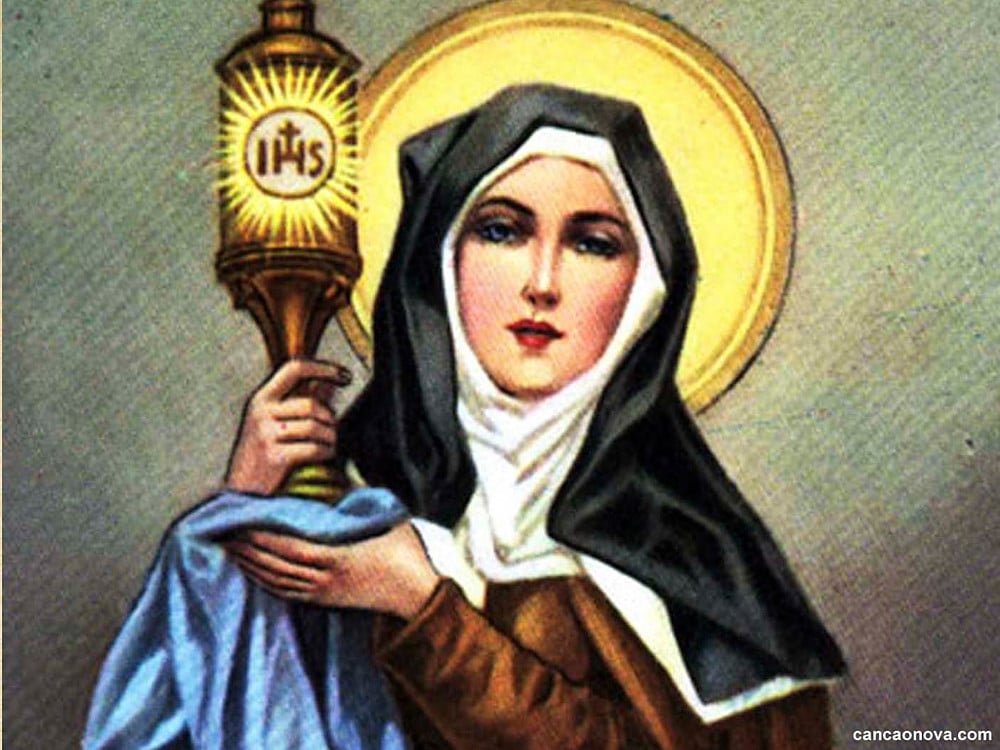
Saint Clare of Assisi
Saint Clare of Assisi, whose baptismal name was Chiara Offreduccio, was born in Assisi, Italy, in 1193, into a noble family. From an early age, he stood out for his generosity and compassion towards the less fortunate. His life would be profoundly marked by his encounter with Saint Francis of Assisi, the most famous saint of his time.
The Encounter with Saint Francis of Assisi
In 1212, when she was just nineteen years old, Clara had a decisive encounter with Saint Francis of Assisi in the church of Santa Maria dos Anjos. Upon hearing his words about evangelical poverty, Clara felt deeply inspired and decided to follow this lifestyle. With great courage, she abandoned her home and family to dedicate herself completely to God.
Clara cut her long hair and wore a modest woolen habit, symbolizing her renunciation of material possessions. Along with other girls, including her sister Inês, she began a new religious life in the Benedictine monastery of São Paulo das Abadessas. Shortly afterwards, they moved to the Hermitage of Santo Ângelo de Panço, where they started a community dedicated to the life of poverty and prayer.
The Foundation of the Poor Clares
The group of girls who joined Clara, following the principles of Saint Francis, were initially called “Damianites”, but later, at Clara’s request, they were called “Poor Ladies”. Later, Pope Innocent III approved the Order and granted the title of abbess to Clare, who, with Francis' approval, adopted the name “Clarissas” for her community.
Clara adopted the Benedictine rules for her Order, but maintained the Franciscan charisma of simplicity and poverty. She became the first woman to write a Rule for a female religious community, emphasizing the importance of following the Gospel and living in evangelical poverty.
The Devout Life of Saint Clare
Clara's religious life was marked by a deep devotion to God and a life of continuous prayer. She spent long hours in adoration of the Blessed Sacrament and sought to live a life of simplicity and humility. His devotion to the Eucharist and his unshakable faith in God gave him great spiritual strength throughout his life.
Saint Clare also stood out for her generosity and compassion towards the poor and needy. She managed the resources of the monastery of Saint Damian wisely, ensuring that those in need were cared for and helping the community to prosper. His example of charity inspired many other people to also dedicate themselves to serving those less fortunate.
The Vision of Television and Other Achievements
Santa Clara is known as the “Patron of Television” due to a mystical experience she had during the celebration of a Christmas mass. While in her cell, she could see, as if projected on the wall, images of the mass that was taking place in the Portiuncula, a sacred place for the Franciscan community. This event led Pope Pius XII to officially proclaim her the patron saint of television.
Furthermore, Saint Clare is venerated as one of the main intercessors for fire protection. A legend tells that, during an enemy attack on Assisi, Clara held the Blessed Sacrament in her hands and courageously faced the invaders. They fled in panic, and Assisi was spared the fire and destruction.
Death and Canonization
Santa Clara died on August 11, 1253, at the age of sixty, in the monastery of São Damião. His life of devotion and service to others left an invaluable legacy for the Church and the world.
Two years after her death, in 1255, Pope Alexander IV canonized Saint Clare, recognizing her exemplary holiness and virtue. His life continues to inspire believers of all ages and backgrounds, reminding us of the importance of simplicity, charity and devotion to God in our own lives.
Conclusion
Saint Clare of Assisi was a courageous, devout and generous woman, whose life was dedicated to serving God and others. Her encounter with Saint Francis of Assisi was a turning point in her life, leading her to follow the path of evangelical poverty and found the Order of Poor Clares.
Her devotion to the Eucharist, her example of charity and her vision of television made her a saint venerated and loved by believers around the world. His legacy remains alive and inspiring, teaching us the importance of following the path of faith and charity in our own lives.